21700 battery: how to fit one and check it
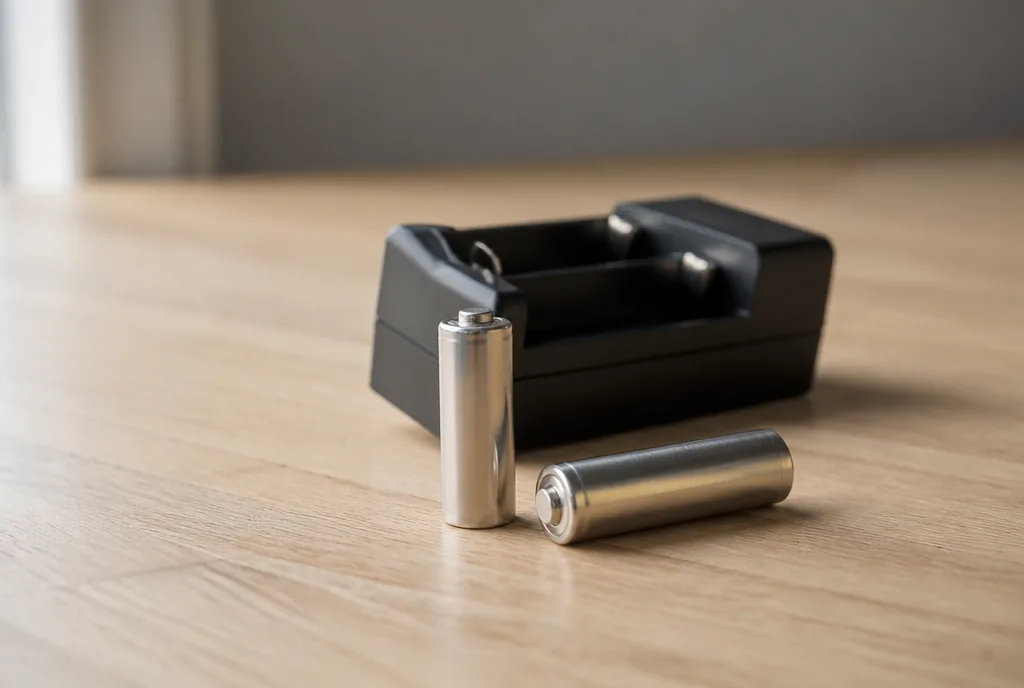
The 21700 format has taken over the mod shelves in British vape shops, and most people who move up to one have never read anything about the cell beyond the capacity printed on the wrap. That is the least useful line on the whole label. A 21700 battery is described by figures the wrap often does not carry at all, and by a ten second inspection that heads off the great majority of incidents. Here is how to fit one, how to keep an eye on it, and how to recognise the moment it should come out of service for good.
Fitting a 21700 battery in the right order
A 21700 battery measures 21 mm across and 70 mm long, with a nominal voltage of 3.7 V. That is where the name comes from, and it is the only part of the specification that never varies from one brand to the next.
- Inspect the plastic wrap: no tears, no scorch marks, no play around either pole.
- Find the positive pole, flat on most vaping cells, and line it up with the diagram printed inside the battery door.
- Slide it in without forcing, then check that the spring in the compartment presses the cell firmly against the opposite contact.
- Switch the mod on and read the voltage it reports, then compare that reading against the figures published by the company that made the cell.
A brand new cell leaves the factory only partly charged. One full charge before first use gives you a clean reference point for watching how it behaves over the following weeks.
Reading the data sheet without picking the wrong number
Capacity in milliamp hours is printed everywhere because it is the easy figure to sell. It describes runtime, and it describes nothing else at all.
The number that actually says what a cell can do is the continuous discharge rating, the current it delivers steadily without leaving its working temperature. It is quoted in amps, it belongs to the cell itself rather than to the wrap it arrives in, and it is the figure a serious manufacturer publishes.
Next to it you will often find a maximum or pulse figure. That one describes a brief peak rather than a working regime, and some sellers push it to the front because it reads better on a listing. Treat the continuous rating as the reference and the pulse figure as a marketing line.
There is a trade off built into the chemistry itself. A cell advertised with very high capacity almost always carries a more modest continuous rating, and the reverse holds just as reliably. Choosing between references means weighing runtime against available current, not reaching for the biggest number on the label.
Matching the cell to what your device asks of it
This is the check almost nobody performs, and it is the one that decides everything else. A regulated mod draws more current from the cell as the wattage climbs, and on a single cell device the whole of that demand falls on one battery.
You will find no figures here, because no article is the right place for them. What your setup demands depends on the device, the coil fitted and the settings in use, and the only authority on what a given cell tolerates is the data sheet published by its manufacturer. Look up the exact reference, read the continuous rating it states, and compare that against the specification your device maker publishes.
Where a mod runs two cells wired in series, the voltage doubles and the current asked of each cell falls accordingly. That is the reason a dual configuration copes with higher wattage while leaning less heavily on either individual cell.
The other reference point is the range printed on the side of the coil itself, and that range is the one to work inside. How those markings are laid out across a range is covered in our guide to Geekvape coils.
Checking the wrap, the ring and the resting voltage
A visual inspection takes a few seconds and does the job far better than any replacement calendar you could write for yourself.
The wrap is the film that insulates the metal can, and on a lithium cell that can is connected to the negative pole along its entire height. A nicked wrap, even lightly, creates a short circuit risk the instant the cell touches anything conductive. A damaged wrap is either replaced with heat shrink in the correct diameter, or the cell is retired.
The insulating ring around the positive pole has to be intact and sitting flat against the cell. Once it lifts or cracks it is no longer doing its job, and the cell comes out of use rather than staying in the rotation.
Resting voltage is what tells you about ageing. Note what the mod reports straight after a charge, then read it again the next day without having vaped. A cell that drifts noticeably overnight has lost capacity and is heading towards replacement.
Using two cells as a matched pair
On a dual battery mod the two cells work together and discharge together. Treating them as an inseparable pair is a rule of operation rather than an optional precaution taken by cautious people.
Buy both at the same time, in the same reference and from the same batch wherever the retailer allows it. Mark them with a permanent pen, A and B, and mark the matching slots inside the door. Charge them together and replace them together, even when only one of the two is showing signs of age.
A fresh cell paired with a tired one spends its life compensating for the weaker partner. The imbalance widens with every cycle and eventually shows up as runtime that collapses for no reason the owner can see.
Carrying and storing cells around Britain
A bare cell loose in a pocket or a bag sits in permanent contact with keys, coins and zip pulls. Because the metal can carries the negative pole, that contact alone is enough to create a dead short.
Use a rigid plastic or silicone case sized for the format, including for a ten minute walk to the shop. For longer storage, leave the cell part charged rather than full, and keep it at room temperature well away from any heat source.
Flying out of a UK airport, spare lithium cells travel in hand luggage only, individually protected against short circuits, and are not permitted in the hold. Pack one case per cell before you leave the house, because airline staff at the gate will ask to see them.
Charging habits are the other half of the job, and the practical markers are set out in our tutorial on the vape battery charger.
Spotting an overstated or counterfeit 21700 battery
The format is widely distributed, and the capacities printed on some wraps bear little relation to what the cell actually delivers. Two clues need no measuring equipment whatsoever.
The first is a listing that claims a very high capacity and a very high continuous rating in the same breath. Those two properties compete for the same volume inside a can of this size, so a wrap promising both at once is selling an argument rather than a specification.
The second is traceability. A serious cell is produced by an identifiable manufacturer whose data sheet is public and states the tested continuous rating. A wrap carrying only a distributor name, with no cell reference and no manufacturer document behind it, allows no verification of any kind. Buy from a specialist British retailer who publishes those details rather than the printed capacity alone, and browse the rest of our step by step section for the neighbouring jobs.
FAQ
The questions that come up most often concern format compatibility, charging habits and what happens at the end of a cell’s working life.
Does a 21700 fit a mod built for 18650 cells?
No, both the diameter and the length are greater. The reverse is possible with an adapter supplied by some manufacturers, which lets an 18650 sit in a 21700 compartment.
Should a cell be run flat before recharging?
No. Lithium ion chemistry has no memory effect, and deep discharges accelerate ageing. Recharge as soon as the mod reports a low voltage rather than waiting for it to cut out.
How many cycles does a vaping cell last?
Manufacturers commonly quote several hundred cycles, with capacity falling away gradually rather than suddenly. Replacement makes sense once observed runtime drops clearly for identical use.
What do I do with a used cell?
It goes into a battery collection point, available in vape shops, supermarkets and household waste recycling centres across the UK. It never goes into general household rubbish.
Can a cell stay in the mod for several weeks?
It is not advisable. The circuit draws a residual current that eventually pulls the cell below its minimum voltage, a threshold beyond which it will no longer charge properly.
Living with a 21700 battery over the long run
A 21700 battery that has been chosen carefully and watched properly gets replaced after several hundred cycles without ever causing a scare. The essentials are short enough to remember: read the manufacturer data sheet before you buy rather than the wrap, inspect the wrap every time the cell is handled, and never break up a matched pair. Everything else turns into an automatic habit inside a few weeks. These reflexes form the base of electrical safety in vaping whatever cell format ends up in the mod, and they cost nothing but attention.
Editorial content for adult readers only. Vaping products usually contain nicotine, a substance that causes addiction. Not for sale to under-18s in the United Kingdom. This article is not a buying recommendation.
Keep reading
Geekvape coils: choosing and fitting the right one
Identify the series of a Geekvape coil, order the right reference, then fit and prime it correctly: the complete tutorial, one stage at a time.
How to clean a vape: the full guide, part by part
How to clean a vape part by part: tank, coil, mod and mouthpiece. The safe method, the mistakes that wreck hardware, and how often each job is worth doing.

Vaporesso Luxe XR Max 2: getting started right
Unboxing the Vaporesso Luxe XR Max 2, priming the right pod, setting the power and the airflow: every move of the first day, taken in the correct order.